Showing posts with label starvation. Show all posts

Monday, December 26, 2011

Some not so random thoughts

.

What greater symbol of the moral bankruptcy of the United Nations than that the General Assembly last week honored a moment of silence for Kim Jong Il and not deceased Czech freedom fighter, Vaclev Havel.

One might have thought that the fall of the Berlin Wall and the subsequent disintegration of the Soviet empire might have been a cue to the apologists, the anti-anti-communists and the whole of the left of the West to give up the ghost and realize that liberal democracy beat the snot out of authoritarian command-and-control collectivism in the battle for the 20th century. However, 20 years on, amaziningly enough, they're still out there bleating away in the darkness.


Here's Pejman Yousefzadeh on this highly dubious and curious phenomena:

One would think that the deaths of Vaclav Havel and Kim Jong Il would prompt universal condemnation for the dictatorial communist regimes the former so bravely fought against, and the latter used for self-aggrandizement at the expense of his own citizens. One would be wrong; the condemnation of dictatorial communist regimes is blessedly widespread, but it is by no means universal.

Consider first Neil Clark, who informs us of the following regarding Havel’s struggle:

No one questions that Havel, who went to prison twice, was a brave man who had the courage to stand up for his views. Yet the question which needs to be asked is whether his political campaigning made his country, and the world, a better place. Havel’s anti-communist critique contained little if any acknowledgement of the positive achievements of the regimes of eastern Europe in the fields of employment, welfare provision, education and women’s rights. Or the fact that communism, for all its faults, was still a system which put the economic needs of the majority first.

(more of this non-sense can be found at the link)


Who could ever forget those economic-needs-of-the-majority-first programs like Stalin's forced starvation of the Kulaks or Mao's Great Leap forward or Pol Pot's killing fields or even today's one-child (or else ) policy in China? Who indeed!

Honestly, who needs antiquated old documents like the constitutions and silly notions like the rule of law and obviously bourgeois concepts like property rights when you're busying yourself with putting the economic needs of the majority first.

And speaking of symbols of disparity: This...


... is not the result of North Korea gaining admittance into the Dark Sky Society.


Dear Lefties, You lost. You got your hats handed to you. Get over it. Take off that Che' t-shirt and quit making stone-cold asses of yourself because anytime you have to start off your defense with, "For all its faults...", you know you've already lost the argument as if the tens of millions of dead at the hands of the socio-economic system you champion wasn't the first clue.

Friday, September 18, 2009

Get to know an American hero


In the 1960s, Borlaug turned his attention to South Asia. India and Pakistan were at war and facing unprecedented famine, with deaths forecast in the hundreds of millions. Indian tests of Borlaug's dwarf wheat seeds were promising, and he traveled there at the request of the Indian government to continue his wheat development program. Despite intense difficulties (including planting wheat under artillery flashes), Borlaug's research resulted in India and Pakistan doubling yields between 1962 and 1970. Both countries were self-sufficient in grain by 1974, and the expected tidal wave of famine deaths had been avoided.

Africa was next on Borlaug's agenda, but by the 1980s he started to face intense opposition from Western environmental groups. Despite his record of success in averting starvation, they opposed his 'Green Revolution' scientific methods -- the use of cross breeding, hybridization, inorganic fertilizer -- as 'unnatural.' Some complained the intensive farming techniques he introduced was displacing traditional subsistence farming, as if starvation by native methods were somehow beautiful and noble. Borlaug would later have be blunt words for these critics:

"many [environmental lobbyists] are elitists. They've never experienced the physical sensation of hunger. They do their lobbying from comfortable office suites in Washington or Brussels. If they lived just one month amid the misery of the developing world, as I have for fifty years, they'd be crying out for tractors and fertilizer and irrigation canals and be outraged that fashionable elitists back home were trying to deny them these things."


Pop’s side of the family shares the same stout but humble Midwest agrarian stock as Norman Bourlag who some estimate saved as many as a billion lives with his work on dwarf wheat, cross-breading and hybridization.

Bourlag passed away this past Saturday at the age of 95.

The ‘Hawk has more here on this true American and world-wide hero.

The next time you read or hear of the devastating effects of America's alleged neo-imperialism or neo-colonialism please keep the memory of Norman Bourlag in your back pocket, won't ya?

Thursday, June 5, 2008

Add another to the list of desirable Brazilian imports


A couple of weeks back, Petrobas, the Brazilian state-controlled oil company announced they had struck oil about 150 miles off the coast of Sao Paulo state. This find sits adjacent to the company’s massive Tupi field which was discovered two years ago and remains the world’s largest find since 2000 and the biggest in the Western Hemisphere since 1976.

Brazilians, though, say they are going to forego drilling and continue their pursuit of alternative forms of energy such as wind, solar and ethanol. Naw, just kidding – they’re gonna drill.

The Brazilians won’t say just how much of that black sticky stuff is setting down there so let’s put it this way: The Brazilians as a result of Tupi and this most recent find, have locked up 80% of the world’s fleet of vessels capable of drilling in deep water and have plans to lease 40 more drilling vessels and semisubmersible oil platforms starting in 2017.

Meanwhile, back in the states, as the price of 87 octane rose to $4.37/gallon here in San Diego, the price-gouging rolls on completely unabated. The gougers profit margin is 15 cents on the dollar as compared to the 4 cents on the dollar that the oil companies make and yet it’s the gougers who have been pitching a fit and have been the ones sounding aggrieved of late with all their grandstanding and worthless hearings.

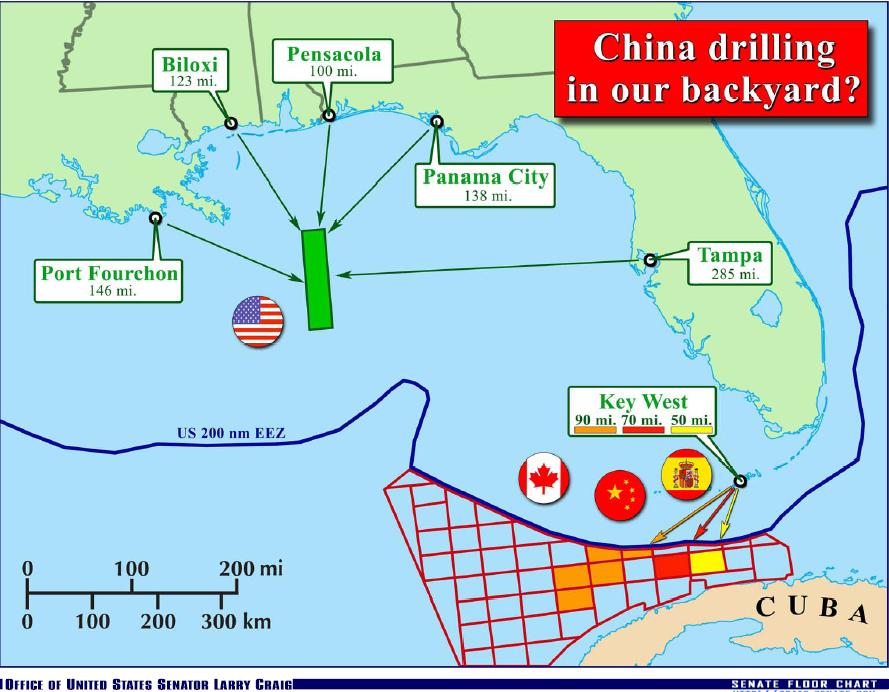
But don’t fret. Just a couple years back an agreement was reached that allowed for off-shore drilling just 50-90 miles off the Florida Keys. Unfortunately, its gonna be these guys. And any bets, they won’t employ slant drilling techniques to tap into our own untouchable off-shore reserves which are part and parcel to the estimated 112 billion barrels of oil in nonpark federal lands in the West, Alaska and under water? Go right ahead. And lets not even get into the abyssmal environmental and pollution track record possessed by these people.

But back to the Brazilians for a moment: at least they get the ethanol thing a bit better than we do. (Story here)

“Corn is food. Turning it into fuel, which is costly and energy-intensive, removes nourishment from the global food supply. Subsidizing corn-ethanol production in Iowa also diverts land from soy, another important staple.
Sugarcane is not a staple. It's eight times more productive than corn. It grows year round. It must be processed fast, so CO2-spewing transport to distant ethanol plants is impossible (unlike for corn).
Its leftover biomass can be used to produce electricity, enough, by some estimates, to provide a third of Brazil's power needs by 2030. Ethanol already accounts for about 50 percent of car fuel in Brazil. The vast extent of unused arable land - only 16 percent is cultivated - offers enormous scope. At $40 per barrel-of-oil-equivalent in Brazil, sugarcane ethanol makes strategic and economic sense.
Yet, the new U.S. farm bill extends the current steep ethanol import tariff - 54 cents a gallon - until 2010, to keep what Brazil makes out. The Iowa boondoggle marches on.”


Could the U.S. Government, if they tried, come up with a more completely counterproductive, wasteful, expensive, up is down, black is white energy policy? Moot question – they already have.