It’s obvious by now that the ethanol industry is like Big Tobacco in reverse. Both have very strong lobbies that assist greatly in keeping their respective industries alive and both burn stuff that is ultimately bad for your health but that is where the similarities end.
Big Ethanol is universally loved by the political establishment where Big Tobacco is reviled. Big Ethanol is an open money pit into which tax dollars are shoveled with no foreseeable return on investment as opposed to Big Tobacco which is taxed relentlessly but only to a degree as the politicians are addicted to its proven tax revenue track record.
Big Ethanol lumbers along receiving more legislative breaks, the more apparent it becomes that ethanol is further and further off from being a viable stand-alone energy source. And Big Tobacco staggers forward amid increasing legislative and regulatory burdens.
On Tuesday, the Obama Administration announced plans via 3 cabinet members that would shield ethanol producers from the credit crisis, work with the same to reduce the usage of natural gas and coal in ethanol production and “nudge” (article’s word) the auto industry towards the production of vehicles that can run on a 85/15 blend without springing leaks all over the damn place.
As far as using less of the bad stuff to produce more of the good stuff, here’s the paragraph that really tickled us:
Scientists differ on the degree to which use of ethanol from corn cuts carbon emissions, if at all. Ms. Jackson, the E.P.A. administrator, said the reduction amounted to about 16 percent, but she said that for both ethanol and biodiesel, the “carbon footprint” could be reduced further if the energy needed to create the fuels were derived from burning plants instead of fossil fuels.
You got that, right? In order to produce more ethanol we need more ethanol to burn in which to produce it.
Only in the Bizarro World that is Big Ethanol can a cabinet-level official say that with a straight face and a newspaper report it with seemingly the same countenance.
It's been a while but there's been some exciting new developments on the ethanol front. Or as we like to refer to it: the absolute worst energy idea ever.
World wheat and maize prices have risen 57%, rice 45% and sugar 55% over the last six months and soybeans are at their highest price for 16 months.
UN special rapporteur on the right to food, Olivier de Schutter, says a combination of environmental degradation, urbanisation and large-scale land acquisitions by foreign investors for biofuels is squeezing land suitable for agriculture.
"Worldwide, 5m to 10m hectares of agricultural land are being lost annually due to severe degradation and another 19.5m are lost for industrial uses and urbanisation," he says in a new report.
"But the pressure on land resulting from these factors has been boosted in recent years by policies favouring large-scale industrial plantations.
"According to the World Bank, more than one-third of large-scale land acquisitions are intended to produce agrofuels."
(italics, ours)
Sure, there are many factors that go into what determines the price of food but explain to us how taking arable land out of food production helps increase the world food supply?
And on the environmental front, ethanol has proven itself to be so green and wonderful for the environment, this is what the EPA has to say about some key pollutants:
At the same time, other vehicle emissions may increase as a result of greater renewable fuel use. Nationwide, EPA estimates an increase in total emissions of volatile organic compounds and nitrogen oxides (VOC + NOx) between 41,000 and 83,000 tons. However, the effects will vary significantly by region. Areas that already are using ethanol will experience little or no change in emissions or air quality. However, those areas that experience a substantial increase in ethanol may see an increase in VOC emissions between 4 and 5 percent and an increase in NOx emissions between 6 and 7 percent from gasoline powered vehicles and equipment.
This comes precisely at the time that the government is cracking down on both Volatile Organic Compounds and Nitrogen-Oxides.
So, armed with this knowledge, what do you think the feds do as Big Ethanol is sitting on a glut of its snake oil? Of course...
For months, administration officials have been hinting that the EPA would approve the ethanol industry’s request for an increase in blend volumes. The industry desperately needs a bailout, because it has built far too many distilleries over the past few years. As Bob Dinneen, president of the Renewable Fuels Association, explained, “We have lots of gallons of ethanol chasing too few gallons of gasoline.”
And sure enough, back on October 13th, the EPA granted Big Ethanol its wish when it approved an increase in the amount of ethanol that can be blended into gasoline from 10 percent to 15 percent. 2/3rds more of a corrosive, hydrophilic, low-heat content element will now be allowed to be blended into our fuel.
This move comes on top of the reality of an already highly-fractured market where refineries in this country produce 45 different blends of gasoline and multiple blends of diesel. The cost of managing this hydra (different fuel pumps, different underground storage tanks) will simply be passed along to the consumer.
There's actually more breaking news that we will share later but we're running long here. When the tingle wears off, go on over to our blog buddy Harrison's place, who, like us, is very excited for the prospects of ethanol.
More expensive, drives up the cost of food, not good for the environment, heavily subsidized and thus highly politicized... what's not to love about ethanol?
Alternate headline: I pimped corn ethanol for the votes, otherwise corn ethanol is a complete loser.
Maybe it's the fact that the man has no designs of ever getting back into politics or perhaps it's because he has now made millions off of taxpayer-subsidized green investment - because whatever it is, this recent bout of truth-spasming, though, quaint is too little, too late.
Former U.S. vice-president Al Gore said support for corn-based ethanol in the United States was "not a good policy", weeks before tax credits are up for renewal.
U.S. blending tax breaks for ethanol make it profitable for refiners to use the fuel even when it is more expensive than gasoline. The credits are up for renewal on Dec. 31.
Total U.S. ethanol subsidies reached $7.7 billion last year according to the International Energy Industry, which said biofuels worldwide received more subsidies than any other form of renewable energy.
"It is not a good policy to have these massive subsidies for (U.S.) first generation ethanol," said Gore, speaking at a green energy business conference in Athens sponsored by Marfin Popular Bank.
"First generation ethanol I think was a mistake. The energy conversion ratios are at best very small.
"It's hard once such a programme is put in place to deal with the lobbies that keep it going." He explained his own support for the original programme on his presidential ambitions.
Wishing to drive up the price of food worldwide in return for an alternative energy that you know is bad policy is just what a man has to do in order to be President, we suppose.
A food-versus-fuel debate erupted in 2008, in the wake of record food prices, where the biofuel industry was criticised for helping stoke food prices.
Gore said a range of factors had contributed to that food price crisis, including drought in Australia, but said there was no doubt biofuels have an effect.
"The size, the percentage of corn particularly, which is now being (used for) first generation ethanol definitely has an impact on food prices.
"The competition with food prices is real."
A slow clap for this tool is definitely in order.
He supports 2nd generation biofuel technologies, however, as it does not compete with food. 2nd generation technologies such as cellulosic technologies which use chemicals or enzymes to extract sugar from the fiber in wood, waste or grass, as examples.
As we will take a look at later, however, these 2nd generation technologies are just as energy intensive or even more so to produce than corn ethanol. Forgive us for thinking then, that this supposed "come to Jesus" moment is less that than Big Al signaling he's merely moving on to the next big taxpayer-subsidized gravy train.
If there is a worse alternative energy idea than corn-based ethanol, we have yet to see it. Despite growing evidence and data that reveal what a bad deal is ethanol, we continue our tax payer-subsidized head-long plunge deeper into this horrible idea. And now, in California, we have more bad news regarding ethanol that will, no doubt, be ignored by our law-makers and regulators.
Attempts to clean up our air and to ensure that the nation has enough milk to drink are on a collision course.
As a result, the future of California's dairy industry looks sour. Around 100 farms are expected to go bankrupt this year alone, and the trend seems likely to continue if nothing is done.
Because of the demand for grain to produce the gasoline additive ethanol - which was supposed to reduce air pollution - plus a nationwide drought, many of the state's cash-strapped farmers are selling their cows for slaughter because they can't afford to feed them. It's a "perfect storm," says Colin Carter, professor of agricultural economics at UC Davis, that could spell trouble for the county's milk supply - 1 out of 5 glasses of milk consumed in the United States comes from California cows. And the increasing price of grain is hurting all livestock industries.
The drought conditions are bad enough as it is and we compound the problem by doubling down on stupid as the federal law mandating ethanol in gasoline now consumes one-third of the nation's corn crop, a percentage that only looks to go higher.
So far, 6 states have petitioned for relief via an escape clause contained within the ethanol law. The EPA, in an emergency, can temporarily lift the mandate. Frankly, given the ideological bent of this particular EPA, we don't see that happening. Besides, even a temporarily lifting of the mandate would expose what an awful sham corn-based ethanol is.
That the actions of the Environmental Protection Agency should be so far-reaching as to effect the price of food and availability of fuel demonstrates how far outside the box the agency has grown.
By 2050, there will be 9 billion people on this planet and they are going to need to be fed but try reasoning that reality to the flat-earthers within the enviro-zealot community.
AgSouth advertised the foreclosure sale of the plant in Thursday’s Soperton News.
Repeated phone calls to Range Fuels over several days were not returned. The company’s website disappeared in October.
Justin DeJong, a spokesman for the Department of Agriculture, said in a statement Thursday night: “We are disappointed that this company did not succeed, and we will be working on behalf of the American people to protect the federal government’s interest in the loan.”
In its statement, the Department of Agriculture said it had worked with AgSouth “on options to revive operations, but on October 27th notified the lender that it was moving forward with liquidation, because liquidation is seen as the best way to preserve U.S. assets and reclaim funding.” The department said it anticipates that there are “a number of companies” that could be interested in the site.
There’s ample reason for outrage here. Range had claimed it could make ethanol at efficiencies far greater than those being achieved by corn-based ethanol producers. Tad Patzek, chair of the petroleum and geosystems engineering department at the University of Texas at Austin and a veteran critic of the biofuel craze, told me that Range’s failure “was easily predictable based on the thermodynamic inefficiencies of the refineries. But no one in the Department of Energy paid any attention.”
Allow us to translate: It took more energy to produce the ethanol than that same ethanol would yield.
More from Bryce:
Instead, federal bureaucrats were once again gulled by extravagant claims from people like Khosla and a cadre of high-profile national-security types, who continue to claim that ethanol and other biofuels will somehow save America from the evils of foreign oil. And the federal bureaucrats were convinced even though a small dose of sixth-grade math would have shown that large-scale development of wood-based biofuels was little more than a pipe dream.
We're pressed for time right now but we are going to revisit this issue later on as time permits and as related to some breaking news yesterday.
We know you are waiting for the other shoe to drop but we have yet to locate any Obama crony/donor/bundler in this particular case. Shocking, we know.
Suffice to say, however, yet another misguided plunge wasting tens of millions of tax-payer dollars into a not-yet-ready-for-prime-time alternative energy technology.
A couple of weeks back, Petrobas, the Brazilian state-controlled oil company announced they had struck oil about 150 miles off the coast of Sao Paulo state. This find sits adjacent to the company’s massive Tupi field which was discovered two years ago and remains the world’s largest find since 2000 and the biggest in the Western Hemisphere since 1976.
Brazilians, though, say they are going to forego drilling and continue their pursuit of alternative forms of energy such as wind, solar and ethanol. Naw, just kidding – they’re gonna drill.
The Brazilians won’t say just how much of that black sticky stuff is setting down there so let’s put it this way: The Brazilians as a result of Tupi and this most recent find, have locked up 80% of the world’s fleet of vessels capable of drilling in deep water and have plans to lease 40 more drilling vessels and semisubmersible oil platforms starting in 2017.
Meanwhile, back in the states, as the price of 87 octane rose to $4.37/gallon here in San Diego, the price-gouging rolls on completely unabated. The gougers profit margin is 15 cents on the dollar as compared to the 4 cents on the dollar that the oil companies make and yet it’s the gougers who have been pitching a fit and have been the ones sounding aggrieved of late with all their grandstanding and worthless hearings.
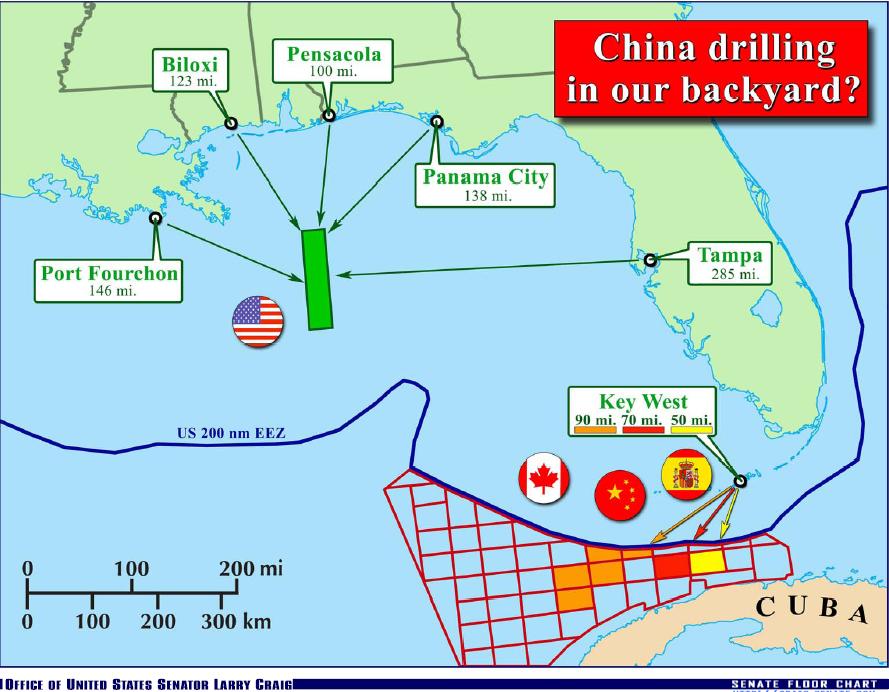
But don’t fret. Just a couple years back an agreement was reached that allowed for off-shore drilling just 50-90 miles off the Florida Keys. Unfortunately, its gonna be these guys. And any bets, they won’t employ slant drilling techniques to tap into our own untouchable off-shore reserves which are part and parcel to the estimated 112 billion barrels of oil in nonpark federal lands in the West, Alaska and under water? Go right ahead. And lets not even get into the abyssmal environmental and pollution track record possessed by these people.
But back to the Brazilians for a moment: at least they get the ethanol thing a bit better than we do. (Story here)
“Corn is food. Turning it into fuel, which is costly and energy-intensive, removes nourishment from the global food supply. Subsidizing corn-ethanol production in Iowa also diverts land from soy, another important staple. Sugarcane is not a staple. It's eight times more productive than corn. It grows year round. It must be processed fast, so CO2-spewing transport to distant ethanol plants is impossible (unlike for corn). Its leftover biomass can be used to produce electricity, enough, by some estimates, to provide a third of Brazil's power needs by 2030. Ethanol already accounts for about 50 percent of car fuel in Brazil. The vast extent of unused arable land - only 16 percent is cultivated - offers enormous scope. At $40 per barrel-of-oil-equivalent in Brazil, sugarcane ethanol makes strategic and economic sense. Yet, the new U.S. farm bill extends the current steep ethanol import tariff - 54 cents a gallon - until 2010, to keep what Brazil makes out. The Iowa boondoggle marches on.”
Could the U.S. Government, if they tried, come up with a more completely counterproductive, wasteful, expensive, up is down, black is white energy policy? Moot question – they already have.
An idea as stunningly awful as ethanol could not survive without the full force and weight of the federal government behind it… fueled, without logic, of course, but by your tax dollars.
Federal ethanol-fuel policies forced consumers to pay an extra 0.5 percent to 0.8 percent in increased food prices in 2008, and the government itself could end up paying nearly $1 billion more this year for food stamps because of ethanol use, according to a new government report.
The report by the Congressional Budget Office helps answer questions raised by Congress last year as food prices shot up, and some lawmakers questioned the effects of government policies, such as the ethanol mandate.
“Producing ethanol for use in motor fuels increases the demand for corn, which ultimately raises the prices that consumers pay for a wide variety of foods at the grocery store, ranging from corn-syrup sweeteners found in soft drinks to meat, dairy and poultry products,” the CBO said.
Also, government-sponsored subsidies and mandates for ethanol to be mixed with gasoline are supposed to help foster U.S. energy independence and to cut down on greenhouse-gas emissions, but only have reduced greenhouse-gas emissions by less than one-third of 1 percent.
All of which means, we haven't been pursuing ethanol as vigorously as we should be. Damn the toropedos, Full speed ahead!
An Associated Press investigation that was reported out on earlier this week absolutely hammers the practice of corn-based ethanol (aka the worst alternative energy idea ever) as fuel for being environmentally counterproductive and not the return on investment financially the those in Big Corn say it is.
How bad is it for Big Corn? Here’s the lese from the AP’s expose’:
The hills of southern Iowa bear the scars of America's push for green energy: The brown gashes where rain has washed away the soil. The polluted streams that dump fertilizer into the water supply.
Even the cemetery that disappeared like an apparition into a cornfield.
It wasn't supposed to be this way.
Outlined against a blue-gray October sky, the Four Horsemen rode again. In dramatic lore their names are Death, Destruction, Pestilence, and Famine.
So, consider our surprise then when the administration that is absolutely addicted to horrible alternative energy implementation ideas said that via the EPA, they were scaling back ethanol production mandates.
The Obama administration on Friday proposed to reduce the amount of ethanol in the nation's fuel supply for the first time, acknowledging that the biofuel law championed by both parties in 2007 is not working as well as expected.
While the proposal highlights the government's struggle to ramp up production of homegrown biofuel s that are cleaner-burning than gasoline, it is unlikely to mean much for consumers at the pump.
The change would reduce by almost 3 billion gallons the amounts of ethanol and other biofuels blended into gasoline in 2014 than the law requires.
The 2007 law tried to address global warming, reduce dependence on foreign oil and prop up the rural economy by requiring oil companies to blend billions of gallons of biofuels into their gasoline each year. But politicians who wrote the law didn't anticipate fuel economy to improve as much as it has in recent years, which reduced demand for gasoline.
How bad is it for Big Corn that this administration may be finally acknowledging reality? That reality being even without ethanol we have become increasingly less dependent upon foreign oil. (We need to find the link but a widely reported study has this country being energy independent by 2025. In case you were wondering, this is a good thing.)
Reality being that many oil and natural gas reserves we are now tapping into in the Dakotas, western Pennsylvania and upstate New York are in the very rural areas ethanol purports to help. Reality being that, prima facie, burning food to run your Prius makes absolutely zero sense.
We applaud the administration for acknowledging these realities that we have been hammering away on for years.
Ethanol advocates claim that the biofuel is a cheap, renewable energy source that reduces pollution and our dependence on foreign oil. It sounds too good to be true—and it is.
Ethanol, especially the corn-based variety, is bad for taxpayers, bad for consumers, bad for the environment, and horrible for the world's poor. In fact, even environmentalists are critical of ethanol subsidies these days. The ethanol craze has distorted markets and increased the price of food worldwide. The only people who still support ethanol subsidies are the ethanol producers—and politicians from both sides of the aisle. Together, they make sure the subsidies keep coming.
What do you think would happen to the stock market if the President came out tomorrow and said he was going to work towards lifting the ban on off-shore drilling? What if he said he was going to do that on the condition that the oil companies use state-of-the-industry technology and that the EPA would be living in their back pocket, extracting major fines for violations? Do you think that might be a boon to the markets? Do you think that might be a far more reasonable way to lessen our dependence on foreign oil than what we're doing now?
Shoot, we’d even allow for a portion of Big Oil profits to subsidize alternative energy research and production. You heard that correctly. We would gladly allow for that because anything…. anything is better than the counter-productive non-policy we have right now.
Unfortunately, the adults aren’t calling the shots right now and they haven’t been for quite a while.
...two 'Merican kids stickin' it to the heartland.
Well, looky here:
We are writing to make you aware that we do not support an extension of either the 54 cent-per-gallon tariff on ethanol imports or the 45 cent-per-gallon subsidy for blending ethanol into gasoline. These provisions are fiscally irresponsible and environmentally unwise, and their extension would make our country more dependent on foreign oil.
Subsidizing blending ethanol into gasoline is fiscally indefensible. If the current subsidy is extended for five years, the Federal Treasury would pay oil companies at least $31 billion to use 69 billion gallons of corn ethanol that the Federal Renewable Fuels Standard already requires them to use. We cannot afford to pay industry for following the law....
Eliminating or reducing ethanol subsidies and trade barriers are important steps we can take to reduce the budget deficit, improve the environment, and lessen our reliance on foreign oil. We look forward to working with you on responsible energy tax policy.
So where did this come from? American Enterprise Institute? Cato? Heritage Foundation? The newly-minted tea party caucus in Congress? Wrong on all four counts.
This was part of a letter to Senate leaders from a bipartisan group of 12 senators and which was co-authored by Diane Feinstein and John Kyl.
We're almost speechless. There has to be a catch, though, right? The term "bipartisan" normally scares the crap out of us. They have to be angling towards something, right?
Can an energy policy be so horrifically bad, so wrongheaded and dreadful that it could inspire a letter this forceful from two people generally at the opposite ends of the political spectrum? And can it be pulled off without malice or forethought? Putting the cynic inside us aside, yes, dear friends... yes it can.
There is obviously a long way to go with political considerations for senators from regionally-affected states and the no-small-matter of the Iowa caucuses in a little over a year but its a great first step. With that in mind, let us rejoice in the opening salvo in the battle to defeat the worst energy policy idea of all time.
The NWF (National Wildlife Federation) alleges that crafting the Renewable Fuels Standard, which requires a certain amount of transportation fuel sold in the United States to contain renewable fuel, Congress limited biofuel feedstock production and harvesting to agricultural lands. Natural ecosystems such as grasslands, are not supposed to be converted for agricultural uses, they claim. However, the report notes, the EPA is flaunting this important provision by adopting an “aggregate compliance approach”, which allows protected ecosystems to be destroyed for biofuels production.
“Plowing up our nation’s last remnants of native grasslands to grow more corn for ethanol is like burning the Mona Lisa for firewood,” says Julie Sibbing, Director of Agriculture programs for the National Wildlife Federation.
(italics, ours)
Nice analogy.
It's telling that our heavily-subsidized and inefficient head-long plunge into renewable energy also requires breaking the law.
And just how bad is ethanol? Even the high priest of Big Green, Al Gore, thinks its a crappy idea.
"One of the reasons I made that mistake is that I paid particular attention to the farmers in my home state of Tennessee, and I had a certain fondness for the farmers in the state of Iowa because I was about to run for president."
Wishing to drive up the price of food worldwide in return for an alternative energy that you know is bad policy is just the sort of craven behavior a man needs to display in order to be President, we suppose.
For more reasons on why ethanol is quite possibly the worst idea ever, check out B-Daddy's itemization, here.
A round-up of articles, news items, columns and blog posts that caught our eye this past week.
B-Daddy has some thoughts on a potential Palin presidential run in 2012.
I am always torn by her, she is so unapologetic for my so many of my core values that I can't help but smile when she zings the media, the left and Obama. But she doesn't inspire my confidence, in the same way that Obama didn't inspire confidence in the 2008 elections.
As much as our side disliked John McCain, I respected him for this, he could wade into a hostile town hall meeting, take tough questions, and provide answers without losing his cool. Neither Obama nor Palin seem able to do so. Obama still can't after two years on the job, and I frankly don't think he is very intelligent.
While we largely agree with this assessment, we're not looking forward to a Palin run for a very different reason: the level of savagery and unhinged hatred that would be unleashed upon her would be unprecendented and detract from real issues that need to be addressed by this country as we decide who the next President will be. We would worry for her safety and that of her family's.
Just this past week, on his radio show, MSNBC personality, Ed Schultz called Laura Ingraham a "slut", twice, in case anyone misunderstood him the first time around. Ingraham is a second-tier conservative radio host. Expect more of the same new civility we've all been told we need to be practicing to be directed at Palin but on an order of magnitude or two larger should she decide to run. The mere thought of what we will read and see over the next 18 months should this come to pass is already making us sick to our stomach.
And Leslie at Temple of Mut has some thoughts on Palin Derangement Syndrome in the media, here.
Michael Ramirez... best in the biz.
Honduras is back in the news a bit as legally-deposed former President Manuel Zelaya who had been in exile has been allowed to return to Honduras and thus will return Honduras to everyone's good graces. Left Coast Rebel has the goods, here.
The biggest news this week is that the TSA and Department of Justice managed the bully the Texas legislature into withdrawing its bill to make groping genitalia without probable cause illegal. In related news Rand Paul managed to single handedly delay the extension of the 'Patriot' Act and its surveillance without court orders to the last minute but not past expiration. Does this mean Rand Paul has bigger balls than the entire Texas legislature?
Note that there are dozens of stories of how Obama is going to reduce regulation and streamline agencies. Frankly I think its a big lie and I won't link to those stories here until something good actually comes of it. So far their main accomplishment seems to have been figuring out that spilled milk is not the same as an oil spill.
What a great resource. Thanks, Shane!
There he goes again...
Of all the prospective GOP candidates out there, we are inclined to make the most excuses for or rationalize the most for Mitt Romney. He exudes a CEO-like competence in spades over most of the field and.... that hair, man, that hair.
It was an odd setting for a policy pronouncement, but on the sidewalk outside the Historical Building here, former Massachusetts Gov. Mitt Romney embraced ethanol subsidies. It came just days after and blocks from where his rival for the Republican presidential nomination, Tim Pawlenty, said the subsidies should be phased out.
“I support the subsidy of ethanol,” he told an Iowa voter. “I believe ethanol is an important part of our energy solution for this country.” Iowa leads the nation in the production of corn, a main source of ethanol.
(sigh)
We already showered earlier this morning so we'll save some water by keeping our mouth shut and not even attempting to defend this stupiditiy.
The United States is running out of a rare gas that is crucial for detecting smuggled nuclear-weapons materials because one arm of the Energy Department was selling the gas six times as fast as another arm could accumulate it, and the two sides failed to communicate for years, according to a new congressional audit.
The gas, helium-3, is a byproduct of the nuclear-weapons program, but as the number of nuclear weapons has declined, so has the supply of the gas. Yet, as the supply was shrinking, the government was investing more than $200 million to develop detection technology that required helium-3.
As a result, government scientists and contractors are racing to find or develop a new detection technology.
And finally, more incoherency on illegal immigration. Here's DNC chair Debbie Wasserman-Schultz not making a whole lot of sense:
I think the president was clearly articulating that his position — the Democrats position — is that we need comprehensive immigration reform. We have 12 million undocumented immigrants in this country that are part of the backbone of our economy. And that is not only a reality but a necessity. And that it would be harmful if — the Republican solution that I’ve seen in the last three years is that we should just pack them all up and ship them back to their own countries, and that in fact it should be a crime and we should arrest them all. I mean that was the legislation that Jim Sensenbrenner advanced a couple of years ago.
Never mind that the establishment wings of both parties are in bed with one another on this subject, it's telling the lack of any middle ground that can be negotiated over when the other side simply refuses to acknowledge the fact that illegal immigrants are breaking the law and indeed committing a crime.
At first, we we dreaded it and then we began to embrace it: A developing condition that was the result of being so vehemently opposed to the policies and politics of the sitting President that we were considering going squishy on some previously-thought-to-be-ironclad litmus tests regarding GOP candidates.
So, this is what pragmatism feels like!
Such was the case with ethanol subsidies and though ethanol is perhaps the worst energy idea of all-time, its Iowa caucus-bound sway appeared to prevent any in the current GOP field from speaking out against them.
Until now...
In announcing his candidacy for President in Iowa yesterday, Tim Pawlenty, also declared for the phasing out of energy subsidies including that of ethanol.
Click here to hear that portion of the speech where he also calls out the thuggish antics of the NLRB who are attempting to block Boeing from opening a plant in South Carolina which happens to be a right-to-work state.
"The truth about federal energy subsidies, including federal subsidies for ethanol, is that they have to be phased out,"
We're far from throwing our hat in the ring for anybody but it is encouraging to hear a mid-westerner address the third rail of Republican primary politics in Iowa of all places.
The North Korean regime executed Kim Jong Un's former girlfriend and 12 members of a couple of musical groups. They were accused of selling pornos of themselves and some apparently were found with Bibles on them. One person was executed via a mortar round. Charmed, we're sure.
Good news for U.S. farmers is not so good news for the 3rd world and developing countries with respect to food prices.
Mr. Obama, a Democrat, nominated Sen. Ken Salazar of Colorado as secretary of the interior and former Iowa Gov. Tom Vilsack as agriculture secretary. Mr. Obama said that Mr. Vilsack "led with vision" and "understands the solution to our energy crisis will be found not in oil fields abroad but in our farm fields here at home."
Shoot, we’d settle for oil fields right beneath our feet but that lacks that whole “vision” thing – way too easy. Additionally, it is noted that since Obama has not been accused of or linked to any wrongdoing in this article, it's safe to print his party affiliation.
But back to biofuels and ethanol: Just when we thought that this idea would die a nice quiet death, slowly crushed under the weight of its own stupidity, it’s back… and not only is it back, it too is looking for a handout.
"The Renewable Fuels Association, a trade group for the U.S. ethanol industry, has spoken with staff members from Capitol Hill and President-elect Barack Obama’s team and “provided them with some ideas on how to craft the language of” an economic recovery package, said Matt Hartwig, a spokesman for the RFA.
Hartwig said RFA has suggested a number of steps including setting up a $1 billion short-term credit facility so ethanol producers could finance current operations; a $50 billion federal loan guarantee program to finance investment in new renewable fuel production capacity and supporting infrastructure; and a requirement that any auto maker receiving federal aid only produce new vehicles that can run on any blend up to 85% ethanol, beginning with the 2010 model season.”
Yes, you would be correct in figuring here that we are going to bailout an industry that is essentially a bailout of sorts in the first place. Of course, playing connect-the-dots, we will be subsidizing cars from Detroit that no one wants to buy, the purchase of the same which will be incentivized by rebates (more of your tax dollars) and where those very cars that have been subsidized on the production and purchase ends will be fueled by a subsidized form of energy that is inefficient, drives up fuel prices, drives up food prices and is ultimately harmful to the environment.
wow. We stand in awe. The monumental and breathtaking calamity that is this arrangement is stunning in both breadth and depth and is something that could only be concocted by the Parliament of Whores that currently resides in D.C.
Fred Thompson is looking more and more prescient every day.
Hey, do you know who is against California’s push for alternative/green energy? Alternative/green energy is, that’s who. Well, Big Ethanol is, to be precise.
The California Air Resources Board under the Mao-like vision of AB 32 is attempting sweeping changes to reduce carbon emissions in fuels and this includes a cradle-to-grave effort in energy development and production.
CARB regulators would establish standards which would grade how fuels are developed. For instance, if bringing a fuel to market requires a large carbon foot print because of the production of fertilizer or transportation costs or the development of said fuel requires clearing CO2-absorbing rain forests or the taking of what would otherwise be arable land for food production then that fuel will be down-graded. You can see how ethanol/bio-fuels would not fair well in this type of classroom.
Big Ethanol, as you can imagine is not pleased by these developments and feels they are being unfairly singled-out and that they “offer a bridge to the newer generation of biofuels that show promise but are not ready to fill gaps in the market.”
Jeesh. We’ve been building this damn bridge for 30-40 years and we really aren’t getting any closer.
And, of course, the irony of the situation where the governmental apparatus that has propped up the ethanol industry for years has now trained its sights on that very same industry and may prove to oversee its demise is not lost on us. Pickin’ the winners and losers, baby!
Congress finally put a stop to the ethanol boondoggle but apparently that memo didn't get to the EPA which has, wait for it... granted a waiver for the sale of E-15.
In January, the EPA issued a waiver that allowed E15 (gasoline with a 15 percent ethanol blend) to be sold for vehicles with model years 2001 and later. This decision was made at the behest of the ethanol industry, but it will come at the expense of American drivers.
While the EPA deemed E15 environmentally safe for models produced after 2001, this higher blend of gas could seriously damage cars. Don’t take my word for it, just ask those who built them.
I sent letters to the major U.S. automakers to investigate how E15 would affect people’s cars. The response was startling. Overwhelmingly , I received complaints that E15 would void warranties, damage engines, and lower fuel efficiency. To date, I have received twelve responses, and all twelve oppose the EPA’s waiver.
Just a reminder, gang: we gave billions in subsidies to a "green" energy industry who's product has a production carbon footprint larger than that of gasoline's, is more expensive to produce than gasoline, does not yield the same energy output as gasoline, makes food more expensive and is most/very likely to shorten the life span of the equipment it is powering.
That's right: Ethanol. The absolute worst energy idea of all time and the EPA doubles down by permitting the production of E-15.
First up is a reminder why the IRS is a rogue and un-accountable agency and should be abolished.
The agency has apparently targeted tens of thousands of small businesses with form letters asking them whether they have under-reported cash revenues. There is no rhyme nor reason as to who gets these letters and why they are getting them so the implication is clearly that these businesses have, indeed, not been compliant with the tax code and thus time, money and resources are expended by Mom and Pops when they clearly do not have these in ample supply in order to answer the IRS and their baseless implied accusations.
At the link, here, is Entrepreneur’s “5 Reason the IRS’s New Focus on Small Businesses is Ridiculously Egregious.”
4. The IRS isn’t transparent.
Want to know how the IRS has determined that your business might be underreporting cash sales? Tough. Clearly there is an algorithm based on reporting from banks and credit-card companies, but the IRS isn’t offering the extent that data is used. In fact, it is offering very little. It only says that the businesses receiving the letters have reported cash sales that are “unusually low.” It is difficult to refute any accusation when you don’t know what information went into it in the first place. Is it based just on the percentage of cash sales? Does the algorithm take into account the average size of a transaction? Are some sectors being targeted more than others? Business owners know nothing about why they are getting these letters.
The sooner we get to a flat tax or some sort of national sales/consumption tax and put these bureaucratic thugs permanently out of business, the better.
Central to the article is the political class policy taste-maker’s unhealthy and unholy obsession with ethanol. What's not to like about about a massively tax payer-subsidized alternative fuel that bad for your car’s engine (alcohol), is not as energy efficient as gasoline, has a larger carbon footprint with respect to producing and bringing ethanol to market than gasoline and is responsible for driving up food prices worldwide in an increasingly hungry planet?
Yeah, insert locker room humor as to what your buddy sees in what is clearly his mean, unforgiving and ball-busting girlfriend. It’s gotta be something, huh?
Well, in the case of ethanol we know what that something is: a hugely disproportionately powerful farm lobby and the hugely disproportionately powerful Iowa Caucus as one of the first events on the Presidential primary calendar every 4 years, where no candidate in either party is going to come out against ethanol subsidies and the renewable fuel standards to which it is wed.
McCain on ethanol (excerpts from a speech made in Ames, Iowa no less, this past November):
"Yes, I oppose subsidies. Not just ethanol subsidies. Subsidies. And not just in Iowa either. I oppose them in my own state of Arizona. I am a proud of the conservative tradition that the government can sometimes best serve the interests of the American people by knowing when to stay out of their way
There is no economic force on this globe that is stronger than free people. Entrepreneurs lie at the heart of innovation, growth, and advancing prosperity. Entrepreneurs should not be shackled by excessive regulation that raises the cost of business. Entrepreneurs should not be disadvantaged by earmarking and pork-barrel spending that favors politically connected competitors.
I trust Americans, I trust markets and I oppose subsidies. As President, I'll propose a national energy strategy that will amount to a declaration of independence from the risk bred by our reliance on petro-dictators and our vulnerability to the troubled politics of the lands they rule. That strategy won't be another grab bag of handouts to this or that industry and a full employment act for lobbyists."
We like it when McCain talks to us like this and we'll freely admit that this ability to tell Iowan farmers probably what they didn't want to hear was fully underappreciated by us.
We have a Naval Reservist in our office doing his 2 weeks active duty rotation. In real life he works for an investment firm that specializes in green and renewable energy for public utilities. We’re big fans of “money”… as in “private money”… as in “what’s the private money doing?” as this is a great indicator of the relative strength of an idea or technology as there is inherent risk with private money… public money (your tax dollars invested by the Government), not so much.
This is why we supported President Bush when he denied federal funding for embryonic stem cell research. Moral dilemmas aside, if stem cell research was the medical Big Idea, then why wasn’t there the amount of private investment there that would suggest it was so?
Anyway, we asked him: “Where’s the green money going?” “Batteries”. “Batteries?” “Yeah. There is promise in wind and solar power but unfortunately, when its needed at peak hours in the evening, the wind dies down and the sun sets. This is the problem with that technology currently, so the money is going towards finding ways to store the megawatts of energy that can be used when the demand is there.”
What’s the money doing with ethanol? Not much. The smart money knows its ultimately a dead end.
When Paul Krugman, the Wall St. Journal and the Cato Institute can all agree on something, then you know you are about as close to a case of the “science being settled” as you will ever get.
The chart below represents the amount of finished motor gasoline supplied by the nation’s refineries and one will note that the curve bends downward as one would expect during a recession.
Unfortunately, Congress did not take this into account when they ordered the nation’s refineries to blend a rising volume of ethanol and other biofuels into gasoline – 15 billion gallons of biofuels by 2012 which is more than double the amount that had been blended in ’07 when this mandate kicked in.
With Americans buying more fuel efficient cars and with even more fuel efficient cars on the way, we’re left with a glut of a fuel type that doesn’t burn any cleaner than gasoline nor is it any cheaper and which represents only 3.5% of our gasoline consumption yet consumes 20% of the U.S. corn crop with the added benefit of doubling the price of corn worldwide.
It's doubtful one could devise a more counter-productive alternative enegy product than ethanol.


 Posts
Posts