Generally speaking, we're down with the notion that the internet and wireless communication in general is a boon to decentralized information dissemination and, as such, a boon to democracy. But every so often we are also reminded that the internet/wireless technologies are still subject to the whims of those that own the infrastructure.
A few weeks ago I hired a company to create an I Phone application for my congressional campaign. My designers told me when we started that Apple would take about two weeks to approve the app after they finished the design and coding.
They submitted the app and then we waited and waited and waited.
Recently the designers contacted Apple to find out what was taking so long.
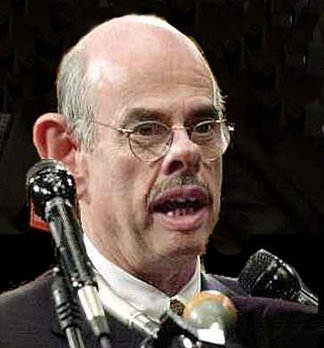
A couple of days ago Apple responded and told us that they were rejecting the submission, and that they were doing so on the grounds that content in the app is defamatory of my opponent, incumbent Henry Waxman.
Here are the statements that Apple found defamatory.
Follow the link for what can only be described as an accurate description of Henry Waxman's voting record as attempted to be brought to light by Congressional candidate Ari David. Scandalous.
Apple... hmmm... Now where did we first here about the folks at Apple?
Of all the sneaky tactics practiced in Washington D.C., this recent action by Congressman Henry Waxman (D-CA) is one of the most insidious: While no one was looking, he injected amendment language into the Wall Street Reform and Consumer Protection Act of 2009 (H.R. 4173) that would expand the powers of the FTC (not the FDA, but the FTC) to terrorize nutritional supplement companies by greatly expanding the power of the FTC to make its own laws that target dietary supplement companies.
This is a little-known secret about the FTC and the nutritional supplements business: The FTC routinely targets nutritional supplement companies that are merely telling the truth about their products. Some companies are threatened by merely linking to published scientific studies about their products.
Apparently, the Federal Trade Commission is having a jobs summit of its own but is focusing on how to rescue the journalism industry and one of the keynote speakers this week was Henry Waxman (D-Mars) who trooped down from the Hill in order to make his case for a government bailout of the newsies.
"We cannot risk the loss of an informed public and all that that means" because of market failure, Waxman said. But he also said the government would need to tread carefully and he set up some ground rules for considering possible solutions that ranged from tax law changes and nonprofit status to antitrust law changes to a review of "cross-media laws that may constrain the commercial vitality of the industry." He said he had an open mind about all the proposals and thought they should all be discussed.
The author of cap and trade, legislation that will essentially dictate what forms of energy we all will be permitted to subsist upon and which as a result plays picking winners and losers with respect to entire industries and the people it employs is worried about the need for government to tread carefully? Beautiful.
First, he said, there should be consensus both inside and outside the media industry that the proposal is in the public interest. Second, it would need bipartisan support and "vigorous enforcement from both sides of the aisle." He said any public model would have to address the concern that "government control of journalism would lead to government control of content," as well as articulating the scope and dollars required, plus what the source of revenues would be.
Vigorous enforcement? Like what? Fines? Jailtime like Pelosi refused to rule out for non-compliance with Obamacare? And how exactly do you “address” concerns that the feds and its bureaucratic lackeys won’t be calling the content shots? You can’t because there is no explaining away the inevitable conclusion that federal money will have a corresponding effect on content control. And sources of revenue? Please.
The morning session also featured media policy activists, public broadcasters and proponents of nonprofit journalism making the case for government funding of the media.
That sounds like quite a diverse group who would be stellar defendants of the 1st amendment.
And what did some of these free speech advocates have to say for themselves:
"As a civil society, we don't trust the open market or the free market" to provide such valuable services, said Jon McTaggart, the senior vice president and chief operating officer of American Media Group, and neither should the media be allowed to suffer because of market forces.
Valuable services like putting food on the table, flying virtually anywhere in the world, performing open-heart surgery and providing automotive transportation. Uhh, put a partial scratch through that last one.
Eric Newton, vice president of the journalism program at the Knight Foundation, called the idea that government has never been involved in media a "mythology. "It's a bogus argument that just keeps us from doing the right thing," he said.
Newton’s exactly right. One of the finer examples of the government gettin' involved in the journalism business was back when President Lincoln didn't trust the free market to provide such a valuable service to society either and was shutting down newspapers left and right and throwing people in jail for what they were printing during the Civil War.
The fact that many of these people who are now lining up at the government trough cut their teeth in underground journalism and the free speech movement of the 60s or who are its direct cultural and ideological descendants and who'd rather swing from their love beads than be caught shilling for federal handouts is particularly galling and demonstrates just how intellectually bankrupt the statist nature of the New Left really was.
With their guy in the White House and owning majorities in both the House and Senate, Democrats can afford piques of honesty when it comes to legislation they are pushing. Piques of honesty in the text of the legislation that betrays what they are saying publicly.
Case in point is cap and trade where “displaced workers” or what normal people call “folks who will lose their jobs as a result of cap and trade” will be eligible for some handsome compensation
Adversely affected employees in oil, coal and other fossil-fuel sector jobs would qualify for a weekly check worth 70 percent of their current salary for up to three years. In addition, they would get $1,500 for job-search assistance and $1,500 for moving expenses from the bill's "climate change worker adjustment assistance" program, which is expected to cost $4.2 billion from 2011 to 2019.
For a bill that’s all about jobs, that provision seems to be a pretty sizable hedge that it’s not. Because the bill only passed in the House by a 219-212 margin, you can bet that the bill would’ve gone down to defeat were it not for provisions like this to swing votes from states like West Virginia, Pennsylvania and Ohio. We wrote about another such multi-billion dollar sweetener, here.
But back to jobs…
While the analyses assume displaced workers will eventually find jobs, the liberal-leaning Brookings Institution predicts a net job loss of 0.5 percent over the first 10 years that carbon reduction legislation, called "cap-and-trade," is in effect. The conservative Heritage Foundation found that by 2030 net job losses would top 1.1 million, while the Coalition for Affordable American Energy, an industry group, estimates that more than 3 million jobs would be lost by 2030 as a result of the cap-and-trade system.
Throw out the last two for the sake of partisan argument and even the Brookings Institute is skeptical.
And then there this:
Job losses probably would not happen right away, even if Congress meets President Obama's deadline for a bill by the end of the year. Its main provisions do not take effect until 2012.
"I doubt there will be a bunch of people filing for assistance when the bill first launches because it won't have a huge economic effect for at lease five years," said James Heintz, associate director for the Political Economy Research Institute at University of Massachusetts at Amherst, who co-authored a study on job creation under the bill.
Ya hear that West Virginia and Ohio? Everything is cool for at least another 2-3 years. What’s that? You’re out of work, anyway? Well then, this cap and trade thing looks better and better all the time.
Saving the best for last:
The billions of dollars that would finance the unemployment fund would come from polluters under the cap-and-trade system. The system requires companies and entities that pollute to pay for the right to emit carbon dioxide above government-established limits.
This is the equivalent of telling a company that has to lay off workers because of a down-turn in the business cycle that the company is also responsible for generous long-term unemployment compensation to those former workers.
It’s a double whammy. Not only does cap and trade try to legislate polluters out of business, they are on the hook for employees they have to lay off as a result of an increasingly hostile business climate as dictated by Congress.
(UPDATE #2):Last weekend we wrote about the yawning gulf between our elected representatives and the voting public being central to the angst of the public currently and, in particular, to that of the Tea Party movement.
From a stimulus bill that no one read to the energy/cap-and-trade bill that we can confidently assert was apeed-read by at least a single young House hall monitor, the Star Wars cantina scene extra that patched this thing together provides yet more evidence of this gulf.
I really have no idea what's in this bill. It's just a bunch of sciency stuff that the scientists told me to put in it.
Actually, we're not being fair to Waxman. There is at least one provision in the bill that we assume he's aware of: unemployment benefits. Buried deep within the near-1,000 page bill is a defacto admission that either the cap and trade scheme is a job killer or that this bill won't produce the amount of green jobs it promises... or, possibly both. (H/T: Hot Air)
(here endeth this update)
(UPDATE #1):This is your government. This is your government on speed.
Democrats in the House Energy and Commerce Committee have taken a novel precaution to head off Republican efforts to slow action this week on a sweeping climate bill.
Republicans on the committee have said they may force the reading of the entire 946-page bill -- as well as major amendments that measure several hundred pages -- all aloud. This is a procedure lawmakers have a right to invoke. Republicans are largely against the bill, which aims to cut emissions of so-called greenhouse gases by more than 80% over the next half-century but would be costly.
Republicans haven't tried the tactic, but Committee Chairman Henry Waxman (D., Calif.) is prepared.
A committee spokeswoman said the speed reader -- a young man who was on door duty at the hearing as he awaited a call to the microphone -- was hired to help staffers. After years of practice, the panel's clerks can read at a good clip. But the speed reader is a lot faster, she said.
Looking on the bright side of things, we guess it’s a good thing that it’s the hall monitor that actually reads the crap this body legislates. And here’s the part where we try to muster some surprise or indignation about Congressional proceedings but we currently do not have the energy to do so. We try to keep that old adage in mind but while real sausage may contain no real net nutritional value, at least it tastes good.
(here endeth the update)
Recall the the boatload of public grief that both Hillary Clinton and Dick Cheney received for the secrecy held in attempting to form health care and energy policy, respectively during the first terms of Bill Clinton and George W. Bush.
So, how come the Star Wars cantina scene extra is not receiving the same scrutiny for fashioning the energy policy that will include cap and trade?
On Friday, House Energy and Commerce Committee Chairman Henry Waxman (D-Beverly Hills) released the closely-held details of his bill rationing energy use in the name of global warming, the American Clean Energy and Security Act of 2009 (ACES).
The details had been kept secret for two reasons. First, Waxman had been working desperately to buy off key Democrats on his own committee -- such as Virginia’s Rick Boucher and Michigan’s John Dingell -- whose states would suffer hugely under the “cap and tax” scheme, plus others with energy-intensive employers in their districts. He succeeded by, in short, giving energy use ration coupons to select employers for resale to some poor saps without Washington lobbyists.
As originally envisioned, these coupons or permits were to be bought and sold on a trading market - the proceeds of which were, in turn, going to fund a middle-classs tax cut. (Never mind the fact that the cost of purchasing these permits by private industry would’ve been passed right down the chain resulting higher gas, coal and natural gas prices). Turns out, however, a full 85% will be “given away”.
Read more, here, and you get the sneaking suspicion that you may have seen this movie before. ACES may as well be "The Return of Porkulus" because just as Porkulus really had nothing to do with stimulating the economy, it appears that ACES, in actuality, doesn’t really have much to do with reducing carbon emissions.


 Posts